Showing posts with label Karen Marie Nielsen (1845-1926). Show all posts

Saturday, July 25, 2015

{History of Mapleton} Hans Peter and Karen Marie Nielsen Jensen

This is from The History of Mapleton, by Ralph K. Harmer and Wendell B. Johnson, on page 143.

Hans Peter Jensen was born June 20, 1844 in Denmark. He was the son of Jens Peder Pedersen and Karen Hansen. His parents were farmers and he spent his early life working on their farm. As he grew older he found work in a nearby city and it was here that he met his future wife.

Karen Marie Nielson was born January 6, 1845 at Torslev Denmark. She was the daughter of Niels Pederson and Maren Andersen. When she was fourteen her mother died and she was forced to earn her own living. This she did by working in other people’s homes, scrubbing their floors, milking the cows, and spreading fertilizer on their fields. It was too hard of work for a young woman and it left its mark on her.

Hans Peter and Karen Marie were married November 5, 1869. About a year after their marriage Hans Peter heard the Mormon missionaries speak and was much impressed by their doctrine. His cousin Chris Sorensen had been responsible for this, but Hans Peter’s family were quite bitter when he and his wife joined the Mormon church. To keep from having any trouble with mobs, the young couple were baptized about midnight March 5, 1871. They had to cut a hole through ice that was two feet thick and their clothing froze to them as soon as they got out, but no one troubled them.

In June of 1871 the young couple left Denmark to come to Utah. They arrived in Salt Lake City on July 24th and then traveled to Spanish Fork. They lived in Spanish Fork for a year and then moved down by the lake where they rented a farm for about two years. Sometime later, they moved to Mapleton and bought a farm at about 60 South and 1600 West. During this period of their lives Hans Peter went on two different missions back to Denmark, but both were cut short and he had to come home because of illness.

Hans Peter and his wife were both hard workers. They often told of dreams that they had which helped keep them on the straight and narrow. Hans devoted much time administering to the sick and helping out his neighbors; as a result, he was liked and respected by almost everyone who knew him. His wife was also a respected member of the community.

Hans Peter and Karen Marie’s family consisted of Caroline, Erastus, Joseph, Mary Eliza, Hans Peter, Niels Christian, Allie Morris and one other son who died in infancy. Joseph, Pete, and Chris all spent the major part of their lives working and living in Mapleton. Peter bought his father’s farm after his health gave out and Joe and Chris were well established in the center of town.


Karen Marie Jensen passed away March 9, 1926 in Spanish Fork where she and her husband had moved after selling their farm. Shortly thereafter, Hans Peter moved back to Mapleton and lived in a small home by his son, Joseph, near the center of town. He spent a few years there and then lived with his daughter Mary Eliza at Spring Lake until he died in 1931. His funeral was held in Mapleton and he was buried in the Spanish Fork cemetery.

Tuesday, October 1, 2013

Hans Peter Jensen (1844-1931) and Karen Marie Nielsen (1845-1926) histories, Part 12: Patriarchal Blessings and Cemetery Map

Part 5
Part 6
Part 8
Part 9
Part 10
Part 11

Note from Marcelaine: I decided not to share the patriarchal blessings here due to the sacred and personal nature of patriarchal blessings. If you would like to read them, leave me an email address where I can send those pages to you, or you may be able to order a copy on lds.org under Sign In/Tools (people who are not members can still request ancestors' blessings). Here I will share just the first sentences that have useful information for genealogy.

Patriarchal Blessings

We have copies of Patriarchal Blessings for both Hans Peter and Karen Marie. In the case of Karen Marie, we have what is assumed to be on original paper, written on both sides in faint ink and a beautiful script, but with several errors of fact. These apparent errors have been retained in the transcription. Punctuation and other matters of style and grammar have been preserved as in the original. It is left to the reader to discern where these differences are and to understand the true meaning. Later transcriptions of both blessings, in the same handwriting, are also available. The later transcriptions also contain apparent discrepancies. For example, the date in the somewhat hard-to-read original, appears to be 1899, not 1879, as in the later copy. The 1899 date is probably more consistent with other dates in his life. The name of Karen Marie in the original is spelled Carn Mary. In the second transcription, someone has corrected the name to Karen Marie. The spelling of her birthplace is also different from other records that we have. We assume that the blessing, still in the hands of her descendants, was simply misspelled by the clerk.

Hans Peter

A Patriarchal Blessing of Hans Peter Jensen, son of Jens Petersen and Karen Hansen, given on Jan. 10, 1898. Born at Hjorring, Denmark, on 20 June, 1844. Blessing by Patriarch Chas D. Evans.

Spanish Fork City Dec 15, 1899

Karen Marie

A Patriarchal Blessing given Dec 15, 1879, by Zebedee Coltrin upon the head of Carn Mary Neilsen Jensen, daughter of Neils Peterson and Maren Anderson. Born Jan. 6, 1845, Faslu Denmark.


Pictures of their headstone can be seen on Find a Grave here.

And this is the end of this history!

Hans Peter Jensen (1844-1931) and Karen Marie Nielsen (1845-1926) histories, Part 11: Thoughts By a Grandson, Morris/Maurice J. Bissell

Part 5
Part 6
Part 8
Part 9
Part 10

Hans Peter Jensen and Karen Marie Nielsen
By a grandson, Morris J. Bissell
Feb. 9, 1966

When I was a youngster, I lived with Grandpa and Grandma a lot during the summer and some times during the winter; even after I started school, I spent a lot of my vacations with them.

They were an honest, law abiding, and very religious couple. As you all know by now, Grandpa went back to Denmark on two missions for the Church after he had come to this country. Grandpa wanted to take me with him on one of his missions, but Mother was afraid that I would have gotten homesick and caused Grandpa a lot of trouble--which I may have done (missionary calls were quite different in that day). I do not know why Mother objected so much; she always claimed that I was the ugliest baby that was ever born. She could have had Grandpa drop me over the side of the ship.

I look back on it today and wish I could have gone with Grandpa so that I could have gotten acquainted with some of our relatives and learned the Danish language as that was all that was ever spoken when the Jensen family were together. I got so I could understand the Danish language quite well but never could speak it.

Looking back, I wonder if Grandpa and Grandma ate to live or lived to eat. We had morning prayer and an early breakfast (and I mean early), then about ten o'clock, Grandma brought another big lunch out to the field, then at the end of the day, we had supper, another big meal. Before bed and after all the evening chores were done, we had another bowl of bread and milk. There was always a large coffee pot setting on the stove and a large bowl of lump sugar on the table so that any time of the day or night someone dropped in, they had to have coffee. (Us young ones got barley coffee that Grandma made out of roasted barley).

Then, at bed time, we all knelt down and had evening prayer, and Grandpa read to us out of one of the church books, mostly the Bible. Then Grandpa or one of the boys always went out to the corrals and barn to see that the livestock were all right and had plenty of food for the night. The Danish people took great pride in their livestock, and took great care with them. During the summer months when the weather was good, Grandma did all the milking--Grandma claimed the boys were too careless about it—and took care of the poultry. They raised an awful lot of chickens, ducks, and turkeys as well.

Grandpa did all the business for the family when he was home, but when gone, Grandma and the oldest boys stepped in. Grandpa was a very honest and upright man; his word was as good as his bond. He did not accumulate a whole lot of money, but he did acquire an awful lot of friends. I do not think he had an enemy in the world.

I think back and wonder how Grandma accomplished as much as she did. I do not know how she got through all her work and had time to take care of her church duties and do all the shopping. She always had a large amount of washing, ironing, and mending to do. She did not have an electric washer and iron in those days; it was all done by hand. And Grandma made all the bedding too. There were heavy quilts and bed ticks to make and stuff with feathers (which Grandma had saved when cleaning poultry).

On certain days of the week, Grandma traded her butter (which was always in great demand) and eggs to the store for groceries and staples. Everyone liked Grandma’s butter as she was very clean. I think Grandma was one of the cleanest persons that ever lived on this earth. I know that if you did not clean your shoes when you came in from outside, winter or summer, you were sure told about it. And Grandma liked to cook and have people eat at her table. Twice a year on Grandpa's and Grandma's birthdays, all the relations and friends would gather at the family farm and celebrate and visit and eat. If I had not seen it, I don't think I would have believed it, to see so much food on a table at one time. And Grandma was always running here and there to see that everyone got all they could eat.

I do not believe that I ever saw or heard of Grandma loosing [sic] her temper or getting out of patience with anyone. She had a good disposition and when Grandpa was away on his missions she was always cheerful and never showed her loneliness; she always believed that everything would turn out well in the end. One year the grasshoppers took most of the crops so the boys caught and sold grasshoppers (for bounty) at fifty cents a bushel. But Grandma still set a good table.

While I was living with Grandpa and Grandma, they used to get a lot of mail and papers from Denmark, but as I could not read or understand the language very well, I do not know much about their relatives in the old country. There used to be an elderly lady who came to visit with Grandma and Grandma [sic]. They called her Auntie but I never did find out what relation (if any) she was to the family. But I wish we had some of those letters and papers from Denmark now; it would make genealogy so much easier.

Grandpa was a very stern man and when he spoke everyone paid attention. He did not abuse anyone, but if you made a mistake, he did not lose his temper but would give you a talking to that you remembered. He was very religious and I know that he would be proud of a lot of his grandchildren if he were alive today, because of the interest they have taken in the church. And he has same grandchildren that he not be too proud of, although Grandpa never did condemn any one if they got in trouble or need but would do all he could to help.

Grandma was a very kind person; she thought a lot of all children. If any child suffered injury, no matter how slight, she always figured that a hug and a kiss and a piece of candy (which she always had) would always heal it.

Grandpa and Grandma raised a wonderful family and I can truthfully say that I am proud to be one of their offspring; any one else related should be proud as well. I am only sorry that all the relation could not have known them like I did. Words cannot express my feelings toward them.

I hope the younger generation will keep the name of Jensen alive by having a get together every year. And I want to wish them all the luck in the world and hope they keep after the laggards in the family so that they will take an interest so the remembrance of two most wonderful people, Grandma and Grandma [sic] Jensen, will be kept alive.

One of the Family
Maurice (Mully) Bissell

Hans Peter Jensen (1844-1931) and Karen Marie Nielsen (1845-1926) histories, Part 10: Family Experiences with Karen Marie

Part 5
Part 6
Part 8
Part 9

Family Experiences with Karen Marie

Clara remembered that Grandma was a good cook and would make mincemeat pies and sprinkle sugar on top. She made these for parties. She would take them out of the pan and put one on top of the other and then unstack them when they get to the party. They wondered how she could handle the pies without breaking them. She made beautiful flaky crust. Her Danish dumplings were most delicious, so light and not soggy. They were made much like a cream puff; after they were dipped in boiling soup, they were allowed to simmer 30 minutes. She also made Danish pickles out of ripe cucumbers. In one or [sic] her letters to me while I was teaching she wrote “We have been out to Joseph’s today and we had plenty to eat."

Grandma had thick, black hair that came to her knees. Her braids were to her waist when she died. She was small in stature and weighed not much over 100 lbs. She was very fussy about home and clothes. The small hays were white shirts that had to be starched and spotless. The collar was round and came out over the shoulders. The boys dreaded its stiffness.

Grandma moved about at a little "dog trot" doing her work. When she stopped, she was always knitting. She helped with the family budget by making quilts and selling them. She would piece them and every seam had to be steam pressed, with the coal stove iron. She would dampen the seam and then press it.

Marie remembers that “Grandma always had a dish of hard tack candy for the Grandkids. One piece was always given when we came but rarely more than one piece. She was a good cook. She would not let us do the dishes for she was too fussy about how they should he done. The kids enjoyed this. She kept her house immaculate. She used a broom made out of straw tied together. When she scrubbed the floor, she always wiped each spot dry before wetting the next one.

“Uncle Pete liked to dance. He always dressed sporty. Uncle Chris enjoyed sports and, around the family, was quite a clown. Uncle Al had a sense of humor. Joseph was more reserved and quiet. When they were together for a social, they always talked Danish. They would talk and laugh and have lots of fun but those who didn't understand the Danish could only imagine what the fun was about and laugh with them. Then there were those Danish Birthday parties where they had such good eats. They always had two meals, one in the afternoon and the other at night. The men used to play croconole.

“One of the joys of going there in the summer was a large crab apple tree. These crab apples were twice the size of ordinary ones and very good to eat. Then, in the fall, pink grapes grew in a big poplar tree by the house. Fay was always the one who could get those in the highest part of the tree, and course they were the best flavored. The family also made Danish beer (made with browned barley and yeast) and heated it with bread for breakfast; barley “coffee” was also a favorite.”

Clara remembered “the winter Grandma had a dreadful cough the entire winter. They say she had asthma. She finally cured it by drinking hot milk with tallow in it. I never remember her coughing like that again. But I remember her in bed with a gown that was ruffled around the neck and a night cap with a ruffle around it much like the girls wear today except it was made of bleached muslin with embroidery on the ruffle.

“Grandma milked the cow as long as they had one. She always tied a blue bandanna on her head, put on a blue figured apron that had long sleeves and buttoned down the back. Then she stepped into a pair of wooden shoes that were kept just inside the barn door. Grandma was one of the most appreciative people. Her favorite expression, when any one did a favor for her was, “You are so good to me.”

Clara also remembers the old organ that was in the family house where she grew up in Mapleton. Joseoh had traded a horse for the organ. He bought it before he was married and white his father was on his first mission. Grandma Jensen said she spent many hours playing it as she was lonesome while her husband was away. When Joseph married, he took the organ to his new 2-room home. The organ meant a lot to Grandma Jensen and she missed it.

Fern remembered, “ Grandma being ill and lying in a bed that, to me, seemed like it was up on a raised platform; the headboard made of wood. I don't remember much design or carving on it, only along the top and edges. I can still remember thinking the top quilt on the bed always looked so "warm"--maybe made of flannel or warm soft wool—all dark colors.

“l was quite young when they lived in Spanish Fork, but I remember the home and going there and having to take off our shoes to go in the house. I remember the candy in that lovely soup tureen and how we looked forward to that piece she'd always give us. I remember the water bucket and getting to drink out of the dipper. We loved their wooden shoes and were allowed to put them on and clomp around outside. Muriel and I have always looked for and wanted a soup tureen like Grandma’s and some wooden shoes just to have them because of the memories.

"The family was so poor when they first lived in Spanish Fork that someone gave them the head of an ox and that was all of the meat they had for one winter. It cost 5 cents, which was very hard to find, to send a letter to Denmark.

“Grandma's sister, Auntie Caroline sewed for a living. She came to America after she was married. She had one boy named Elwood Christensen, also one girl. Auntie Caroline always joined the family in their family socials. "

Hans Peter Jensen (1844-1931) and Karen Marie Nielsen (1845-1926) histories, Part 9: Her Early Life

Part 5
Part 6
Part 8

Karen Marie Nielsen Jensen

By Harriet Lucinda Whiting Jensen, daughter-in-law

Karen Marie Jensen

Her Early Life

Karen Marie Nielsen was born Jan 6, 1845, at Torslev, Denmark. She was the daughter of Niels Pedersen and Maren Andersen, the seventh child in a family of eight. Her oldest sister died. She began working away from home when she was twelve years of age. When her mother died when she was fourteen, Karen Marie was obliged to support herself from then on.

She lived with "fine folk" as she termed them, but they were very hard on her and only allowed the children a certain amount to eat. Many times she was hungry, but the door was always locked and nothing was given them to eat after the five o'clock supper. The bread was cut thin and only two tiny slices given to each child. She stayed with this family a year and was paid about $8.00 for her work.

At fourteen, children went to the Priest to be confirmed. He lined the boys on one side and the girls on the other and talked to them for a time; then the next Sunday they were allowed to take the Sacrament and given a book. The Priest wrote in the book that they had been confirmed and this was their reference book. No one would hire a person without this reference. At that time, they were hired for a certain length of time and if they left before the time was up, they would not get a reference and could not get another job.

Karen worked at one place two and one half years, but it was such hard work. She was forced to go into the field to work along with the men as well as do the housework. During the harvest, they had to get up at 3:30 or 4:00 o'clock in the morning and get breakfast, and after breakfast, milk as many as ten cows and take care of the milk; she also did the churning. She put up lunches for a ten o'clock lunch, and then came home at noon and milked the cows, washed the dishes, and put up an afternoon lunch, while the men folks took a rest and nap. Many times she helped bind grain until 10:00 o'clock at night. It was at this place that her health broke and she contracted something similar to asthma that bothered her all her life.

One fall, about November, she spread over four hundred loads of fertilizer called “marigal,” a clay that was dug up from the ground. It was unloaded in piles, and the workers had to spread it and break it into pieces. Many times it was very cold, and the fertilizer was so heavy that she thought she would never get it done. But after the day’s work was done, she thought nothing of walking a mile (a Danish mile is four of our miles) to a dance and back again. Finally, she made up her mind that she would quit the farm work and go to the city. She found that this was also hard work because the family she worked for lived in four large rooms and every week the rooms were given a thorough house cleaning. She scrubbed the floors with sand.

While working in the City, she met Hans Peter Jensen, who worked at the same place. They were married Nov. 5, 1869. They were baptized into the Church Jesus Christ of Latter Day Saints (Mormon) at 12:00 midnight, March 5, 1871. It was so cold her clothing was frozen stiff before she could get to the house, a short distance away. Choosing this time of night was necessary to avoid trouble from mobs. They left Denmark to come to Utah in June 1871 and arrived in Salt Lake City, July 24th of that year. From here they went to Spanish Fork, Utah, probably to be with many other families from the Scandinavian countries. After about a year, they rented a farm down by Utah Lake. While living here, two children were born and one of these died. Eight children were born to them while they were living in Spanish Fork.

They were always poor, but the hand of the Lord was with them. He was ever first in her sight and she was blessed by her obedience to Him. She was always a faithful mother as well as a helpmate to her husband, and was loved fer her helpfulness and charity. Her smile was an integral part of her and her jolly laughter always rang through the air.

She carded sheep's wool and from this knitted all her children’s stockings, gloves, sweaters, and wove the cloth for their clothing. She also made piece-blocks, quilts, and rugs, and quilted for other people; she nearly always had a quilt on in her later years. In this way she earned money to buy Christmas presents for all of her family and especially the grandchildren. When she passed away, she had quilts to do for her neighbors. These worried her up until her death because they weren't done.

She loved to dance or be with the crowd out having a good time. She and Hans used to go down to the dance hall in Spanish Fork and watch the young people dance. This was while they were in their seventies. She loved the jolly things in life, and always tried to see the bright side of things.

She was a faithful worker in the church and, for years, was counselor in the Mapleton Relief Society. She stayed at home and took care of things while her husband went on two missions to his native land. By this time the boys were big enough to assume much of the work.

She never forgot a grandchild's birthday and her pennies were saved to bring them joy. She loved their noise and laughed at the things they did. There was always candy or cookies for anyone who went to her home.

She and Hans moved back to Spanish Fork for their later years. They had a little home at 479 North 500 East. It was here that she took ill and was in bed about four days before her death. She didn't seem to be in any pain, just exhausted from the toils of a life well spent. She slept her last few days peacefully away. Her death occurred March 9, 1926, at age 80. She was buried in the Spanish Fork cemetery.

>>Part 10

Hans Peter Jensen (1844-1931) and Karen Marie Nielsen (1845-1926) histories, Part 8: His Last Days in Lake Shore and The Temple Books

Part 5
Part 6

His Last Days in Lake Shore

Hans Peter JensenHis health failing, Hans went to live in Lake Shore (west of Spanish Fork) with Lizzie, his oldest daughter, for a couple years before he died. One time, Harriet went over to help her. First she took the barley and malt that he had and made some beer. When she handed it to him he said, “Oh Sister, you'll never know how good that tastes to me." He only lived a couple days after that.

Thelma Tweede Butler, Lizzie's daughter, had also moved to Spring Lake. She was married by then, but lived close by. She tells the following story:

"Grandpa liked to walk down the road with his cane. Father's horses were very curious and came close to the fence. When he put the cane in the air, they put their ears and tails up and ran. Grandpa would stand and laugh at them."

He died in Spring Lake at Lizzie's home on September 15, 1931. His last request was to be brought back to Mapleton for his funeral. He was buried in the Spanish Fork Cemetery by the side of his wife.

Muriel recalls one incident after Grandpa's funeral that, to her, was a miracle. "The closing prayer was given by Ellis Harmer. As he prayed, he asked that there would be no harm or accident befall anyone on the way to the cemetery. I was young then and thought that was a strange thing to say. There were three cars with the flower girls that went ahead to place the flowers on the grave before the procession got there.

I was in the car with Woodrow Tweede driving. Burton Warren and Uncle Bert Whiting draw the other two cars.

“There was a railroad track that crossed the road just at the top of a hill as we went down into Spanish Fork and some upright cattle guards about 6 or 8 feet from the side of the road on either side of the track so that no cattle would go through there and wander onto the track. Just before we got to them, Uncle Bert and Burton went acress the tracks and stopped on the other side and jumped out of their car to wave us down. By then it was too late, as we creased the track, the train came through where those cattle guards were and I looked right into the cow catcher since I was sitting in the back on that side. If Woodrow had even touched the brake, we would have surely been hit. The Lord had certainly answered that prayer."

The Temple Books

Among the papers of Hans Peter and Karen Marie Jensen are two “Temple Books”, showing their activities in the temple and their lineage and relationships. These are in delicate condition but show temple ordinance records and dates of those listed. They are interesting to study as they tell who was at the Temple and when, which ordinances were performed, and who the proxy was.

>>Part 9

Wednesday, September 25, 2013

Hans Peter Jensen (1844-1931) and Karen Marie Nielsen (1845-1926) histories, Part 7: Return to Mapleton and Family Experiences with Hans Peter

Part 5
Part 6

Return to Mapleton

After the death of Karen Marie, Hans bought the little Relief Society Hall in Mapleton, just west of the home belonging to his son Joseph and Harriet, and lived there for possibly 4 or 5 years. This building was formerly the meeting place for the Relief Society. As was common in that day, Relief Society was held in a separate building rather than the chapel; many of these were built and paid for from the “dues” paid by members of the Relief Society; this one was about a block east of the main Chapel and on the other side of the street and was probably built about 1890.

When the Relief Society no longer needed it, Hans Peter made his home there. The deed to
the property shows that he paid $500 for it in April 1926.


Caption: The Old Relief Society Building still stands behind the home at 195 East Maple in Mapleton, Utah, although its appearance is considerably different than the building in the photo.

Following the death of Hans Peter, the home became the property of Joseph Jensen and was used for a residence for a few years and later for storage. This building is located today behind a newer home at 195 East Maple, in Mapleton. There have been attempts to preserve the building. The bricks have been cleaned and efforts have been made to stabilize the walls. The doorway and access have also been altered.

The pathway through the grass to the front door of the Relief Society building was lined with purple flags (Iris). The outside measurements are 15 x 20 ft. There was no running water inside so water had to he carried from a hydrant at the back of Hattie and Joe’s house. On the inside, a huge wardrobe stood against one wall at the back of the room. On the opposite side was his bed. The stove was a cook stove that was also used to heat the house. A cupboard, with glass in the doors on the top half to show off the nice dishes, stood in the corner. A table and a "Bishop's couch“ completed the furnishing. The couch had a wooden back and arms and a slat seat with a mattress on top to make it comfortable to sit on.

A short distance behind the house was a granary, also made of brick, but a lighter color; it had been used to store the grain kept by the Relief Society for an emergency. Until this building was built, the wheat was stored in the back of the Relief Society Room. Outside and a little north was the outhouse or "shanty," with three holes for seats, each one sized appropriately for the different sizes of occupants.

Family Experiences with Hans Peter

As a little girl, Marie remembers the “Leafy Society" (Relief Society) ladies meeting in this room or building. The Jensen girls, who lived just few steps east, were assigned to help clean. She remembers them singing the hymns with gusto even if some of their voices were a little “screechy.” Marie also remembers playing the pump organ there, powered by pumping the foot petals [sic].

Fern recalls, “After Grandpa moved into the Relief Society house there by us, we really got to know him. He was always an pleasant and “chuckled” over the things we did. He always sat with his back to the door, facing the warm stove, so we'd sneak in the door and go over and grab him and scare him. We loved it as he'd always act as if he were scared and grab us and give us a squeeze for being “naughty.” He loved smoked herring and other kinds of fish and the smell was always in the house. Any time I smell that good smell I am reminded of Grandpa and how he enjoyed the fish.

"I remember him always being so neat and clean. He wore a full heard and kept it so clean and white. I remember how soft it always felt and his hands were soft too. As he got older, Mom would have one of us go get him or walk over to the house to stay for part of the day. We also took turns walking him to Church for each meeting, and were so proud to get to be the one to hold hands and walk with him. This is why his soft hands are so vivid in my memory. And he always thanked us for taking him as if we'd done him such a great favor.

"When he’d come over to our house in the daytime, he had a favorite place to sit by the end of the stove, and lots of times he‘d lean on his cane and just watch the activity going on. He seemed to know that where he sat he was out of Mom's way while she worked. And knowing our Mother, I'm sure she kept a conversation going with him--maybe encouraging him to tell about Denmark. Mother was so proud to tell us that Grandpa had said to her, “Your children honor me." How I wish all this had been recorded.

“He fixed his own breakfast, which was usually “fisk” (fish)--which he bought in a keg and kept in some kind of a brine—and barley coffee. He ate his noon meal with us and had his "supper" at his place, usually bread and milk and smoked fish and sometimes some homemade “beer.” He liked "tin" (thin), not "tick" (thick) soup and loved his homemade "beer" and "coffee"--neither of which were in violation of his strict Mormon ethics.

One of his favorite delicacies was fruit toast. During the summer, we gathered and dried berries. These were soaked and cooked with sweetening, then thickened and poured ever toast. (Some years age this recipe was included in the Relief Society Magazine.)

Fern remembers being a “flower girl" at his funeral. “Each of the smaller grandkids was given a bouquet of flowers and stood on either side of the sidewalk; the casket was brought along the path and the relatives walked alongside; it was probably quite touching and pretty to see and such an honer to get to stand there.”

Muriel also remembers living next door as a young girl, and gives us her perspective of Hans Peter Jensen. “I used to go over to Grandpa's house and build fires for him in the mornings so that he wouldn't have to get up in the cold. I would walk home with him at night when he left our house and I remember what soft hands he had as he held my hand. I would sleep on the couch and he must have waked me in the mornings, as I doubt I was an early riser. He always had the little kindling brought in. I would wad up some paper and put it in the stove and then add the kindling, followed by bigger pieces of wood, then lay the coal on top. He kept a gallon can of kerosene nearby and I would pour a liberal amount over the whole thing and then light a match to it. It would take right off and I would go back home as soon as I saw that the coal was burning.

“Every Saturday, there was always a quarter on the table for me. I have wondered many times since how he could afford to give it to me as money was a very scarce item in those days. One day on my birthday, instead of a quarter, he left me a pretty strand of heads. I can only guess how he ever got those. He was such a kindly quiet man and I know our family all loved him.

“Grandpa Jensen loved his Danish “beer.” This beer had no alcohol in it. He would have it for
supper like bread and milk. On one occasion, He ran out of the beer, so Mother decided to make a batch for him. We had a big screen porch at the back of the house whore she washed and she had two number 3 tubs to rinse the clothes in. We used them to have our weekly bath in also. Well, she scrubbed one of them real clean and made the beer in that. She covered it with a cloth and left it to ferment or whatever it did. Clara and Len had wanted to go on a trip to California, so they brought Alice down for us to take care of while they were gone. She was just a little tyke, about 2 years old. She caught the whooping cough after Clara left so we just tended her as best we could. One day I happened to go out on the porch and there was Alice having the time of her life bathing in the tub of beer. I gathered her out—shoes, socks, clothes and all and called Mother. I was sure that she would be really sick, but it didn't seem to make her any worse. Maybe she drank some and it pepped her up. I did tell Mather that she should measure the contents she bottled it.

"We had a player piano at our home and happened to have the roll of "Midnight Fire Alarm," which I used to love to hear, so I would play it often. Our sister-.in-law, Beth, had the sheet music of the same song. I learned to play it fairly well, but one day decided to put the roll on and played it while was playing with my own hands. The switch where you turned the roll off when it was finished was at the top where I had to put the sheet music. Well, I started to play— better than Mozart himself—and Grandpa heard me and came in the parlor to watch. Of course the darn thing ended, and I had nothing to do but reach up under the music and turn the player off. Grandpa always carried a cane and he shook that cane at me and stalked out of the room.

“One day, three of the cousins, June Whiting Blanchard, her sister Beulah, and Fern Jensen, the youngest daughter of Joseph and Harriet, were playing together. As June remembers the experience, Harriet had just baked an apple pie and came out onto the porch where the girls were playing and handed it to Fern. Fern thought the pie was for three hungry girls, so she went to the kitchen and got three spoons and they enjoyed the pie. Harriet expected that Fern would understand that it was to be delivered to Grandpa in the little house next door."

Thelma Tweede Butler, daughter of Mary Eliza Jensen Tweede, one of Hans Peter's daughters, shares the following memories.

“My Father Herman and his brother went out to the West Mountain and homesteaded a big farm out there. The first recollection I have of Grandpa and Grandma was when I was about 5 years old. ‘There weren't any phones so I don't know how my brother and I knew that Grandma and Grandpa were coming, but we were waiting for them and finally saw the little black buggy coming a long way off and ran to meet them. Grandpa took me on his lap and let me drive the horse; of course, we knew they had a sack of old fashioned candy for us.

When they lived in Spanish Fork, we visited quite a lot. Grandmother always had a quilt on the frames to sew and us kids would have a playhouse under the quilt. When Grandma died, she had a quilt on that hadn't been finished so Mother and some of the Aunts finished it before the funeral. At rest time, they put a pan of sweet beer on to heat and toasted bread on the back burner of the shiny black coal stove. And I had a bowl of hot bread and beer.”

Veda Tweede Durfey, another of the grandchildren, adds, “We used to watch Grandpa drive up whether it was buggy or car. The day that I remember, particularly, they were in a buggy. I must have been about 9 or 10 and was attempting to do some ironing. Grandma asked me if I knew how to iron. I said nothing but went and asked mother what she meant. She always had a little bag of candy with her, so we were glad to have them visit us. One time they had purchased one of the first cars around and we went riding with them. Grandpa, never a good driver, did not see the train coming down the tracks and just about crossed in front of it. We were all pretty shaken up. Grandpa came to live with us for a time. We really enjoyed having him. I don't think he was a burden to us. We missed him when he died.

Hans Peter Jensen (1844-1931) and Karen Marie Nielsen (1845-1926) histories, Part 6: Back to Spanish Fork and A Second Wife

Part 1
Part 2
Part 3
Part 4
Part 5

Back to Spanish Fork

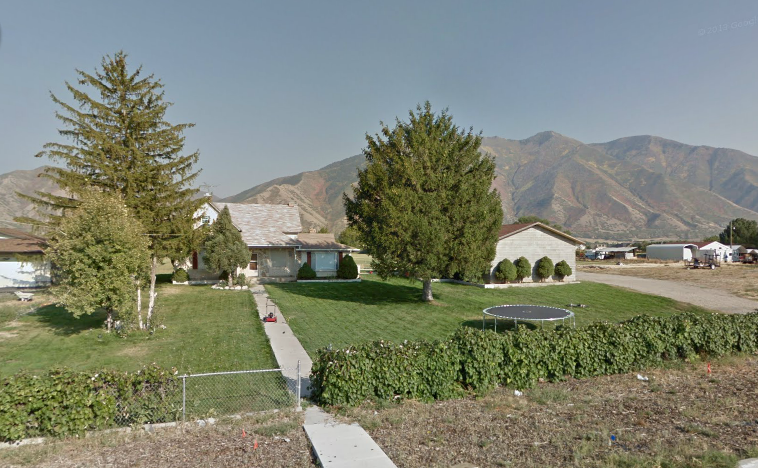
The family was grown and all of the children but Peter were married when they built the brick home in Spanish Fork. The original property was about 1/4 of the block. Directly behind the home were a washroom and the sheds and outbuildings, all linked together according to the Danish custom. There were some animals, principally some sheep and a cow.


[Note from Marcelaine: The first picture is from the history. There is a pickup truck in front, so I am guessing this is a fairly recent picture. The second picture shows the image from Google Maps.]

They lived in this home until Karen's death on March 9, 1926. As of 2004, the home is still standing but has been remodeled; additions to the south and rooms upstairs have been added.

Upon moving back to Spanish Fork, Hans felt that this was a good time to retire. He carried a cane, which was supposed to be a more a symbol of the good life than to steady his walk. It was easy to get to Church (it was just a short distance) and they still had old friends there.

He had Old Roany, a faithful roan horse, that they used when they went to Mapleton about once a week to see the family. Later he bought a Model “T” Ford and sold Old Roney to Joseph. He soon acquired a reputation as a very poor driver as he never slowed for corners. One time, he brought Aunt Lizzie’s daughter from Lake Shore where the Tweedes had moved to Mrs. Martin, a midwife, to have a baby. She thought it was a pretty wild ride. How long he owned the car is not known, but he didn't have it after Grandma died. Some kids had stolen and wrecked it. The family was glad, as he was such a poor driver. Adjusting to the automobile from the horse and buggy was not an easy move for him.

Muriel remembers, "When Grandpa and Grandma lived in Spanish Fork, I remember one Saturday when Dad took us (Marie, Nelda, Fred, Fern, and me) with him for a visit. Dad had a load of wheat to take to the mill to be ground into flour for our winter use. It took awhile to get the flour, so he let us all go to the picture show, "The Ten Commandments." That was a very rare treat indeed. We went back up to Grandma's after the show was over to go back home with him. When we got there, Grandma, who had such a cute little laugh, gave us all a hug. Whenever we were lucky enough to visit her, she always gave us a piece of hard tack candy from a pretty soup tureen that she kept full of candy. Since we seldom got any candy, it was always the high point of our visit.

"Well, as it happened, she didn't happen to have any candy that day. l was crushed to think that she didn't have any. She said that she would fix us a piece of bread with syrup on it, which she did, but I wouldn't eat mine. She asked Marie if I didn't like it and that Marie said, ‘She always eats it at home.’ But I still wouldn't eat it as I was sulking and would rather go hungry."

Fern remembers going to the home as a small girl and having to take off her shoes when she entered the home. Water was carried into the home in a bucket equipped with a dipper, which also served as the drinking cup for the entire family. Fem also remembers their wooden shoes and liked putting them on and clomping around outside.

A Second Wife

There are a few brief references to a second wife for Hans Peter Jensen. Two Family Group records among the surviving papers of Marie Jensen Whiting, both dated April 1928, show two marriages for Hans Peter in the Endowment House on 23 Nov 1874: first to Karen Marie Nielsen and a second endowment and sealing to Ann Marie Jorgensen*. Ann Marie was a convert from the old Country (Denmark). She died 7 Jan 1915 and was buried in the Spanish Fork City Cemetery on a lot owned by Hans Peter Jensen. Karen Marie and Hans were buried there later. A small flat stone engraved “Mother” lies in the grass next to two other stones marked only as “Menna” and "Louis." Harriet Whiting Jensen stated, “Grandfather obeyed the law of polygamy as it was taught by the church leaders and believed that those who entered into it would receive a higher degree of Glory.

Fern remembers a story supposedly told by her mother that she isn't sure is true. As the story goes, when Grandpa Jensen was considering following the Prophet's encouragement to take a second wife, he had a dream one night and dreamed he had tied two of his goats to the same post and that they constantly fought and jerked at the post to get away from each other. Even so, I guess Grandpa felt he had to obey the prophet and took the second wife. Karen Marie evidently cooked meals for Ann Marie, but wouldn't wait on her.

There weren't any children by this marriage, but Ann Marie had five children from a previous marriage: Pete, Mary, Andrew, Menna, and Louis. Menna and Louis both died of typhoid fever.

Ann Marie rarely entered into any of the family social life; instead, she seemed confined to her small one room cabin, later referred to as the washroom, just behind the family home in Spanish Fork and straight out the back door. She lived here until she died. She was blind from a cancer on her face. Little else is known about her.

*Editor's note: The ordinance records actually indicate that Hans Peter was sealed to Karen and was married to Ann Marie for time only, not sealed.

Wednesday, September 18, 2013

Hans Peter Jensen (1844-1931) and Karen Marie Nielsen (1845-1926) histories, Part 5: Hans Peter Jensen Missionary Service


These pages had several pictures. I have transcribed the text and then put images of these pages with the captions to the pictures at the end so you can see the pictures.

Hans Peter Jensen Missionary Service

Hans Peter Jensen served two missions for the Church to his native Denmark. Since his mother lived in Denmark until she was 90, he saw her when he was on his first mission in 1900. He was released early from his first mission, which was a concern to him as he would have preferred to finish his mission. This probably accounts for his serving a second mission, even though Karen was very sick when he left. This second time he had to come home because of poor health.

After his second mission, he was not well enough to do his farm work, so he sold his farm to his son Peter and moved back to Spanish Fork where he and Karen lived until her death on March 9, 1926.

We have several original documents from the Scandinavian Mission that show his service there. The first shows that he was released from service in the Aalborg Conference on March 5, 1901. His date of arrival is
known.

A second document shows that he was assigned again to the Aalborg Conference on May 25th, 1906.

A third document from the Scandinavian Mission shows he was released from service from his second mission on 1 February 1907 from the same conference. The release papers show his passage from Liverpool on the ship SS Cymric leaving on Feb. 7th of 1907.

The last on [one?] the "White Star Line Passager Kontract Nr. 13," written in Danish as well as English, shows the passage being arranged 29 January 1907, traveling first by train and then by steamer for Boston, USA.

No journals or other personal notes of his mission are known to exist. Clare Jensen Arnett provides some notes and clippings that detail the early beginnings of the church in Denmark along with other happenings. The year of these notes, taken from the Diary of the Pioneers, is 1851. Although missionary work in Denmark had begun years earlier, Hans Peter Jensen would likely have been subject to some of the same hostile treatment as other missionaries as indicated in the notes below.

May - The Book of Morman was translated into the Danish language by Peter O. Hansen, and was published by Erastus Snow in Copenhagen, Denmark. It was the first edition of the book printed in a foreign language. The first number of the Eteile du Deseret, (Star of Deseret) a monthly periodical, was published in the interest of the Church by Elder John Taylor. 
August 21 - The saint's [sic] assembly hall at Aalborg, Denmark, was demolished by a mob, which also mistreated some of the brethren. 
Aug 16 - The first General Conference in the Scandinavian Mission convened in Copenhagen, Denmark. Erastus Snow presided, continued fer three days. 
Oct. 24 - Elder Hans Peter Jensen (not our grandfather) and Hans Larsen received cruel treatment from a mob in Bornholm, Denmark for preaching the Gospel. 
A number of the Saints were cruelly treated by a mob in Brondbyoster, Sjaeiland,
Denmark. 
A newspaper clipping, apparently from the Church News dates 1974, June 16, Copenhagen, Denmark-“The Copenhagen Denmark Stake, the first in that country was organized by President Ezra Taft Benson of the Council of the Twelve. Missionary work had begun in Copenhagen in 1850, the first baptisms having taken place in Aug 12 of that year. The first branch was organized the following September, and over the next 80 years more than 26,000 people joined the Church in Denmark.”

Clara also notes, “Grandpa's favorite Apostle was Apostle Widsoe (John A). How he loved to meet him as he could talk the Danish language with Hans. I often wondered why he was his favorite but after reading the “Gospel Net" by John A Widsoe, I know. Grandpa was on a Mission at the same time as Apostle Widsoe’s Mother and her sister and is in one of the missionary pictures with them."

Captions:
Hans, the missionary. The mounting frame identifies the photographer as N.C. Madsen, Aalborg, at address, Algede 57 (Denmark)

Hans is wearing the same black coat, which is still in the possession of the Marie Jensen Whiting Family. It is a winter coat and very heavy.

He evidently likes this nice heavy coat.

Here is the second picture from that page in better quality, taken from Family Search.

Hans Peter Jensen Missionary


Hans Peter Jensen Family Portrait

This picture of the family of Hans Peter and Karen Marie Jensen, with Hans absent, was taken while he was serving a mission to his native Denmark. Front: Hans Peter, Karen Marie, Mary Eliza (Lizzie), Allie Morris. Back: Neils Christian, Joseph, Erastus, Caroline

>>Part 6

Sunday, September 15, 2013

Hans Peter Jensen (1844-1931) and Karen Marie Nielsen (1845-1926) histories, Part 4: His Gift of Healing

Part 1
Part 2
Part 3

His Gift of Healing

Few people had the faith that Hans did. He was always helping with the sick. For example, Albert Milton Whiting, father of Harriet Jensen, had been ill all winter with heart trouble. One Sunday afternoon the family went over and knelt down while Grandpa Jensen offered a prayer. Grandpa Whiting began to improve and was able to go places until his death some months later.

One night when he lived in Spanish Fork, he was coming from the barn after doing chores, and something said, “Go over to your neighbor and administer to her; she is very ill." He walked into the house and told his wife. She said if he were wanted, the neighbors would come after him. He kept thinking about it and finally put on his coat and left the house for the neighbor's. As he entered the house, he could hear a woman crying as if she were in great pain. When she saw him she said, "Oh, brother Jensen, you have come to save my life. I have been praying that you would come. If you will administer to me, I will be healed." He laid his hands on her head and pronounced the blessing. As he took his hands from her head, three gal stones [sic] passed from her and she got well. She said she was [sic] never been bothered after that.

Another time, Hans felt impressed to go to Mendenhall‘s; he had been over earlier in the day assisting with a little sick daughter. About midnight, something awoke him and told him to go help, so he walked back over to Mendenhall’s, a distance of a mile. They had been praying that he would come. The young daughter, Helen, had been ill for some time. Grandpa gave her a blessing. No one could count the trips he made to Mendenhall’s when Helen had a ruptured appendix. Helen got well and went to school for a year before she died suddenly of a heart attack after being to Primary that day. Her funeral was on the lawn at Mendenhall’s and all the Primary children walked to the nearby cemetery after the hearse.

Bruce Mendenhall shares the following about his Grandmother, Eliza Rebecca Tew Mendenhall. "Some time after I was born, Mother was very sick. Brother Hans Peter Jensen was sent for to help administer to her. He said, ‘Sister Mendenhall, do you care if I speak in my own tongue?” He was a returned missionary from Denmark. Mother said, 'No, not a bit.‘ Brother Jensen gave her a wonderful blessing that was the turning point in her recovery. "

Hans Peter Jensen (1844-1931) and Karen Marie Nielsen (1845-1926) histories, Part 3

Part 1
Part 2

Additional Memories

By Clara and Marie

For Hans and Karen, the boat ride across the ocean was very difficult. Karen was ill all of the way. The passengers had to go onto the deck each day for fresh air, but she was too ill to walk, so Hans carried her. She was a small woman, not weighing much over 100 pounds. They had to bring their own food, as the fare was meager, and cooked it in groups, using old pots.

Hans had a brother, Chris, who also came to Utah and lived in Springville. Chris was a tailor by trade. He was married to Rose Allred but later divorced. He had ­several children.

Once Hans and Karen were located in Utah, he was proud of the fact that he had been able to come to Utah without depending on the Perpetual Emigration Fund set up by the LDS Church to help the Saints come to Utah. But they were very poor, as their money was almost gone. Their meat for the first winter was a cow head given to them by one of their neighbors. Karen said of the experience, “There’s much meat on them.” They lived in an old house of Bill Johnson’s in Spanish Fork. Hans made a bed and crossed ropes for springs. They had no chairs that first winter. They ate their meals standing at a window.­ It was a hard struggle to get along, but they managed somehow and also helped to take care of others who came from their homeland later. After living in town for a year of [sic] so, they moved to Lake Shore, just a few miles west of Spanish Fork. The land was flat there so the water was easy to get and they could have fish to eat from
the river. A drought in Sevier County to the south brought traders from the salt mountain to trade for fish to eat.

Their first home in Utah was an adobe house with a thatched roof made of cane. In the summer, they moved into the fields west of town where they stayed in a granary owned by Bill Johnson. He remembers how the roof leaked and the rain poured through. The river at that time ran through the Johnson Farm; in one place the river had changed its course leaving a large area of very rich dirt, so they cleared out a large area of willows to give them extra space to plant potatoes; the story was that the potatoes yielded 900 bushels to the acre.

The first farmland Hans was able to buy was a piece in northeast Spanish Fork. There he built a three-room adobe house (with a mud roof) for his family. Uncle Hansen made the adobes. Taylor Larsen laid them together, and he (Hans Peter) did the carpenter work. Early maps of Spanish Fork City describe the northeast part of the city as “Little Denmark.” The various nationalities tended to live together and preserve some of their customs and language.

Joseph remembered, as a boy, how his father gleaned a little clover along the ditch banks to bring home to feed the cow. He left it in a stack to dry and one day while the parents were at Church, one of the children made a bonfire of the hay.

After the four wards were made, this area was also known as the Fourth Ward. Since the soil in the area was mostly alkali and very poor for farming, he moved to Mapleton for better land. They bought land in Mapleton known as the part of the School Section, the west central part. This would have been after 1890, as records show that all of their children were born in Spanish Fork, except Allie who was born in Mapleton.

Their Mapleton home is located at present at 125 S. 1600 W. Here they raised their family. This house was built of nice red brick, had two stories, and was on approximately 10 acres. It had a parlor, a big dining room and living room, and a large kitchen, and two bedrooms upstairs. The home is located near the head of the Big Hollow, which is probably where they got their water, as there was a nice spring there. The stream of water running through this area was the location of early baptisms in Mapleton and served as a settlement for some of the Indians. The Big Hollow was a large grove of trees just west and north of the intersection of Maple Street and 1660 West (Highway 89). Maple Street continues on to the southwest to Spanish Fork. The Springville Evergreen Cemetery is just a little north.

Jensen Mapleton Home

This home was later sold to son Pete and Ruby when Hans and Karen moved back to Spanish Fork. Stanley, a son of Peter Jensen and Ruby, now (2004) owns the home and has remodeled it. The original home has been covered with a white imitation brick veneer.

Marcelaine's note: I looked up the address on Google Maps and I believe this is the Mapleton House.

Hans and his sons farmed about 40 acres. As was a custom in Denmark, they rose early and had breakfast. Then about 10 o'clock, the mother took out something for them to eat and this happened again in mid-afternoon.

The Denmark winters were very severe with deep snows. At the corner of the farms were very tall posts and on the post nearest the house, they would place a black flag as an appeal if there was illness or if they needed help. Their out buildings were connected together so that they could go from one building to another to take care of the animals without going out in the open weather. Hans built like this in Utah, his sheds attached together like they did in Denmark, but not connected with the house.

The first building was a tool shed, then a granary, and last the chicken coop. The barn was on to the south. Hans was very fussy about everything and had a place for everything. By the tool shed was a large barrel where they put wood ashes and filled it with water. This mixture made the lye they used to wash with as well as their home-made soap. The grandchildren learned early that they didn't put their fingers in it because it made your hands sore. They had a big iron kettle that was used to heat water in to wash. Their daughter Harriet helped make the soap as long as they lived in Mapleton. When they moved hack to Spanish Fork, Hans let Harriet have the kettle with the provision that she wasn't to lend it.

Hans was a carpenter and very handy with tools and made much of their furniture. He also made wooden shoes for the children until they were old enough to go to school. Joseph get his first store shoes when he was four. Before that, he wore his wooden shoes so he could go out in the snow if he wanted. Later, in the teen years, they wore their older wooden shoes on the way to dances and kept their nice new ones to wear at the dance, changing to their nice ones when they got there. Hans had a wooden bench that he sat on that held the piece of wood as he worked on it. His feet, pushing on a lever, provided the pressure to hold the work in the jaws above the bench while he worked the shoes or other project with his tools. The bench is much like what is known today as a shaving horse, a tool rarely seen today except in a museum.

>>Part 4

Saturday, September 14, 2013

Hans Peter Jensen (1844-1931) and Karen Marie Nielsen (1845-1926) histories, Part 2

Previous posts from this history:
Part 1

Hans Peter Jensen

Memories of Harriet Whiting Jensen

A history of Hans Peter, kept by his daughter in-law, Harriet Whiting Jensen, records that Hans Peter Jensen was born 20 June 1844 in Dronninglund, Hjorring, Denmark, son of Jens Peder Pedersen and Karen Hansen. His parents owned a farm and kept two horses, six cows, some young stock, sheep, and other farm animals. The wool from the sheep was used to make cloth for their clothing. They raised flax to make thread and factory-cloth for their underclothing. They had a building for each particular use, and these were connected together with arches or some kind of shelter because of the cold and deep snow that was sometimes six to seven feet deep.

Their fuel was called tara. It was sort of a sod  from marshy places where there had been a grove of trees at one time, and leaves had fallen and packed together. This formation was, sometimes, four feet deep. This was cut into squares and laid out to dry. When dried, tara looked like coal. Pieces of wood were often found buried in the debris. The girls used to wheel out the wet sod in wheelbarrows.

Hans Peter’s second brother got the old home for he married a girl who had money and was able to pay each of the children his or her share so they could keep the home. According to custom, Hans Peter should have had it (property was usually inherited by the oldest son who assumed the responsibility of caring for the parents), but he was poor and would have been unable to take care of his parents the rest of their lives. With the proceeds from his share on the home, he was able to buy a small home, which he sold later for enough money to come to Utah.

At about twelve years of age, he came home from school very sick with a cold and fever. After a while he went back to school, but broke out all over with sores. Everyone said he couldn't live, but his father used pine-tar inside and out until he became well. Sometime after, as he and his brother were coming from school, he was bitten on the leg by a poison snake. His father tied a string tightly around his leg. It swelled so badly that it burst full length. In less than two or three hours the poison ran out. It was more than a month before he could use his leg.

Another time, he fell into a deep hole where men had been getting clay. The hole was nearly filled with water. He could not swim, but by an act of Providence, he was able to reach the side where the wagons had pulled out.

He was married to Karen Marie Nielsen, Nov. 5, 1869. He met his wife when she was living in the city. They both worked at the same gore (or home). They had been married nearly a year when he became interested in the Latter Day Saint’s Gospel, through a cousin, Chris Sorenson. He did very little preaching because he was afraid it would cause trouble with his wife; however, it had impressed him, and he began to study the Bible for himself. His wife became very much afraid because her mother had told them that the Mormons were false prophets and they must beware of them. His father and family were very bitter when they heard he was investigating Mormonism. His wife went to them for aid and help in this trouble. His father had said the baptism, sprinkling, that he had received when he was a baby was all that was necessary.

One time he dreamed that an old playmate came and wanted him to go to a meeting and listen to the Priest talk. This dream came true for his old playmate came and they went to the schoolhouse to hear the Priest. They were sitting near the front where they could see the door. As the minister was preaching of baptism, he said, "The children belong to the Devil until they are baptized, so do not hesitate very long before this ordinance is performed." Grandfather (Hans) could see a man standing at the door who was dressed in a red suit of peculiar make and he knew him to be the Devil. He stood and laughed and scoffed as the Priest spoke of baptism. Hans could hear him plainly. After the meeting was over and they were returning home, he spoke to the others about it and was surprised that they hadn't heard or seen anything. This to him was a real testimony that he was doing ríght by changing churches and that he needed another baptism.

Not very long afterward, he and his wife were baptized. He said afterward that when his friends departed after the baptism, he had one half mile left to go alone, some of the way through a grove. He was so afraid that the devil might torment him some more. Karen was not so very sure that she should be baptized, but the Elders finally assured her that she was doing right so she went with her husband. They were baptized on the fifth of March, 1871; Chris Sorenson spent all day cutting the ice for it was more than two feet thick. When they went to the water (about midnight), the ice had frozen over again. Her clothing was frozen before she could get to the house, a distance of about a block. They were confirmed by Peter Anderson and Lars C. Sorensen, respectively.

They left Denmark to come to Utah, June 21, 1871, and landed in Salt Lake July 24th of that year. They came on to Spanish Fork and lived in town about a year. Then they rented a farm and moved down by the lake, where they lived for two years. Here two children were born and one died. Five days after the baby's death, Hans was crossing the Spanish Fork River in a boat. An old rope used to pull them across the river broke, upsetting the boat, and he tumbled into the water. He always said he could not tell how he came to the other side for he couldn't swim.

They moved to Mapleton and bought a farm. On one occasion after they first moved, Hans was laying out in the wagon box, when a voice came to him from a heavenly being. The spirit was so strong that its influence stayed with him all night and the next day. The voice said, "We are satisfied with you and your family, but there is one person you must not keep company with." It later proved that he was wise in getting away from this evil influence.

Hans Peter and Karen Marie were the parents of eight children, six sons and two daughters. They
were:
  • Caroline, born 12 Nov 1871; died 28 Sept 1950; married John Bissell, 21 Dec 1892 
  • Jens Peter, born 27 May 1873; died 1 June 1873 
  • Erastus, born 27 Mar 1874; died 25 Mar 1919; married Adelaide Maria Fullmer, 11 Oct. 1899
  • Joseph, born 25 Sept. 1875; died 21 Aug. 1948; married Harriet Lucinda Whiting, 5 Dec 1900
  • Mary Eliza ("Lizzie"), born 21, Oct 1877; died 10, Oct 1935; married Herman Tweede, 10 Feb 1897
  • Hans Peter, born 23 Oct 1881; died 3 Apr 1960; married Ruby Snow Warren (widow), 24 Mar 1915
  • Niels Christian, born 17 Sept 1884; died 19 Oct 1964; married Ovilla Whiting, 28 June 1905
  • Allie Morris born 27  1890; died 25 Jan 1943; married Charlotte Gammell, 28 April 1915


In 1931 at the time of his death, he had fifty-two grandchildren and twenty-one­ great grand children.

Grandpa Jensen belonged to the Black Hawk War Veterans even though he never did participate in the war. Probably some of his Spanish Fork friends did as he used to go to their encampments. 

He was a High Priest in the Priesthood and was an active church member. He was an inspiration to his family. He was honest and upright in every respect, always trying to do right and having his children do likewise. He enjoyed seeing the young people dance. After the death of his wife he lived out by his son Joseph in Mapleton, about a block from the dance hall; he often went down and watched the dancing though he was past 80 at the time.

>>Part 3

Hans Peter Jensen (1844-1931) and Karen Marie Nielsen (1845-1926) histories, Part 1

I have decided I am going to start looking for histories of my ancestors and share them on this blog so that they will be more readily available to any of their descendants who would like to read them. If there is anyone who has any of these histories (or other documents with stories), I would love it if you would share them with me so I can make them available to our family here. Please feel free to share any of these posts with people who would be interested.

I am starting with a history of Hans Peter Jensen and Karen Marie Nielsen. They are my great-great grandparents. I have a pdf copy (sent to me by Sue Stevens) that is readable, but the pictures are not great because, as she said, this is a scan of a copy of a copy of a copy . . . Sorry about that. Apparently the original is in the special collections section at the BYU library. If there is anyone in that area who would like to get scans of the original and send those to me so I can put better images here, that would be great. It is about 30 pages long, so I will be breaking it into parts. I assure you it was well worth the read for me (or I would not be bothering to put all this effort into sharing it with you).

Here we go.

*****
Part 5
Part 6
Part 8
Part 9
Part 10
Part 11
Part 12

Hans Peter Jensen and Karen Marie Nielsen

Title Page
Table of Contents
Hans Peter Jensen

Karen Marie Nielsen
(Edit: Somebody uploaded some pictures of Karen Marie and Hans Peter onto Family Search, so I am replacing my terrible quality photos with the better ones from Family Search where possible.)

Foreword

The information presented here is a compilation of family records made available to James William Whiting by his Mother, Marie Jensen Whiting, and from correspondence and oral interviews with family members. These stories represent a collection of several documents written mostly by Harriet Lucinda Whiting Jensen (wife of Joseph Jensen and the 4th child of Hans and Karen), and Harriet and Joseph’s daughters-Clara Jensen Arnett, Marie Jensen Whiting, Nelda J. Carlson, Muriel Jensen Cox, and Fern Jensen Butler. Additional sources are a letter written by Morris Bissell (son of Caroline Jensen Bissell, the first child of Hans and Karen) and the letters of Veda Tweede Durfey and Thelma Tweede Butler, daughters of Mary Eliza Jensen Tweede. It is hoped that other descendents [sic], reading this account, will know of other stories and photographs available through their families and will be willing to add to this record.

Original records are archived in the BYU Special Collections. Please send corrections or additions to: James William Whiting, 153 E 400 North, Springville, Utah 84663, phone 801-489-8116.

- June 2004-


Emigration

THE MINNESOTA (June 1871)

“The first company of this season’s emigration of Scandinavian Saints sailed from Copenhagen in the evening of June 23, 1871, bound for the land of Zion, on board the Steamship “Humber” in charge of President William W. Cluff....The whole company consisted of 387 souls. After a successful voyage; the “Humber” arrived safely in Hull, England, on June 26th, from which place the emigrants were conveyed by rail to Liverpool the following night. After arriving safely in Liverpool in the morning (June 27th), the emigrants, 397 souls, including a Scotch family, embarked on the Steamer “Minnesota,” which sailed the following day (June 28th) with its precious cargo for New York, where it arrived 14 days later (July 12th). From New York, the journey westward (by rail) was resumed on the 13th and the company arrived in Ogden, Utah, July 21st. Here the company was dissolved, some of the emigrants going north, many to Salt Lake City, and others farther south to other cities and towns. The journey from Copenhagen to Utah was made in four weeks....” Two of the passengers on this voyage were Hans P. Jensen and Karen M. Jensen (Source, Mormon Immigration Index).

If the tossing and turning of the ocean for three weeks was not trying enough for two weary passengers and Karen Marie being pregnant, the trip from New York by railroad was not very comfortable either. The year was barely two years following the completion of the Transcontinental Railroad (May 1869). Although surely much easier than by oxcart or handcart, you can imagine this ride would not have been comfortable either. The fare in the summer of 1869 was $150 for first dass and $70 for immigrant. By June, 1870 from New York to San Francisco­ had dropped to $136 for first dass a, S100 for second class, and $65 for third class or immigrant. First Class meant a Pullman sleeping car but immigrants sat on a bench. We can only imagine which category Hans and Karen would be traveling.

Thus begins our story of Hans Peter Jensen and his wife Karen Marie Nielsen Jensen in America.

>>Part 2