Sunday, September 15, 2013

Hans Peter Jensen (1844-1931) and Karen Marie Nielsen (1845-1926) histories, Part 3

Part 1
Part 2

Additional Memories

By Clara and Marie

For Hans and Karen, the boat ride across the ocean was very difficult. Karen was ill all of the way. The passengers had to go onto the deck each day for fresh air, but she was too ill to walk, so Hans carried her. She was a small woman, not weighing much over 100 pounds. They had to bring their own food, as the fare was meager, and cooked it in groups, using old pots.

Hans had a brother, Chris, who also came to Utah and lived in Springville. Chris was a tailor by trade. He was married to Rose Allred but later divorced. He had ­several children.

Once Hans and Karen were located in Utah, he was proud of the fact that he had been able to come to Utah without depending on the Perpetual Emigration Fund set up by the LDS Church to help the Saints come to Utah. But they were very poor, as their money was almost gone. Their meat for the first winter was a cow head given to them by one of their neighbors. Karen said of the experience, “There’s much meat on them.” They lived in an old house of Bill Johnson’s in Spanish Fork. Hans made a bed and crossed ropes for springs. They had no chairs that first winter. They ate their meals standing at a window.­ It was a hard struggle to get along, but they managed somehow and also helped to take care of others who came from their homeland later. After living in town for a year of [sic] so, they moved to Lake Shore, just a few miles west of Spanish Fork. The land was flat there so the water was easy to get and they could have fish to eat from
the river. A drought in Sevier County to the south brought traders from the salt mountain to trade for fish to eat.

Their first home in Utah was an adobe house with a thatched roof made of cane. In the summer, they moved into the fields west of town where they stayed in a granary owned by Bill Johnson. He remembers how the roof leaked and the rain poured through. The river at that time ran through the Johnson Farm; in one place the river had changed its course leaving a large area of very rich dirt, so they cleared out a large area of willows to give them extra space to plant potatoes; the story was that the potatoes yielded 900 bushels to the acre.

The first farmland Hans was able to buy was a piece in northeast Spanish Fork. There he built a three-room adobe house (with a mud roof) for his family. Uncle Hansen made the adobes. Taylor Larsen laid them together, and he (Hans Peter) did the carpenter work. Early maps of Spanish Fork City describe the northeast part of the city as “Little Denmark.” The various nationalities tended to live together and preserve some of their customs and language.

Joseph remembered, as a boy, how his father gleaned a little clover along the ditch banks to bring home to feed the cow. He left it in a stack to dry and one day while the parents were at Church, one of the children made a bonfire of the hay.

After the four wards were made, this area was also known as the Fourth Ward. Since the soil in the area was mostly alkali and very poor for farming, he moved to Mapleton for better land. They bought land in Mapleton known as the part of the School Section, the west central part. This would have been after 1890, as records show that all of their children were born in Spanish Fork, except Allie who was born in Mapleton.

Their Mapleton home is located at present at 125 S. 1600 W. Here they raised their family. This house was built of nice red brick, had two stories, and was on approximately 10 acres. It had a parlor, a big dining room and living room, and a large kitchen, and two bedrooms upstairs. The home is located near the head of the Big Hollow, which is probably where they got their water, as there was a nice spring there. The stream of water running through this area was the location of early baptisms in Mapleton and served as a settlement for some of the Indians. The Big Hollow was a large grove of trees just west and north of the intersection of Maple Street and 1660 West (Highway 89). Maple Street continues on to the southwest to Spanish Fork. The Springville Evergreen Cemetery is just a little north.

Jensen Mapleton Home

This home was later sold to son Pete and Ruby when Hans and Karen moved back to Spanish Fork. Stanley, a son of Peter Jensen and Ruby, now (2004) owns the home and has remodeled it. The original home has been covered with a white imitation brick veneer.
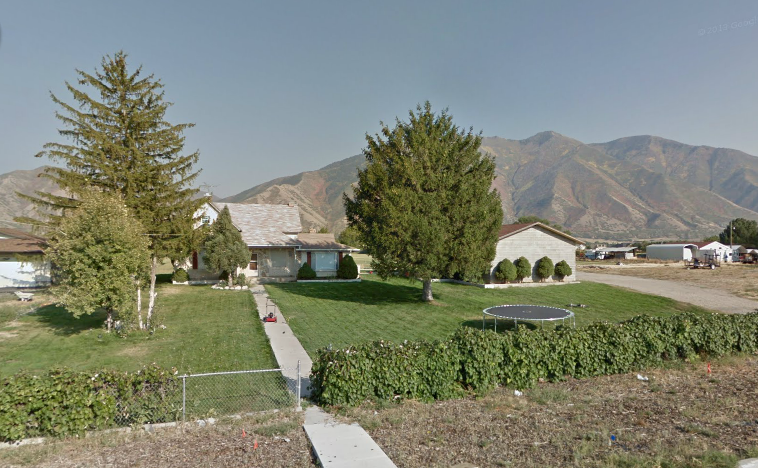
Marcelaine's note: I looked up the address on Google Maps and I believe this is the Mapleton House.

Hans and his sons farmed about 40 acres. As was a custom in Denmark, they rose early and had breakfast. Then about 10 o'clock, the mother took out something for them to eat and this happened again in mid-afternoon.

The Denmark winters were very severe with deep snows. At the corner of the farms were very tall posts and on the post nearest the house, they would place a black flag as an appeal if there was illness or if they needed help. Their out buildings were connected together so that they could go from one building to another to take care of the animals without going out in the open weather. Hans built like this in Utah, his sheds attached together like they did in Denmark, but not connected with the house.

The first building was a tool shed, then a granary, and last the chicken coop. The barn was on to the south. Hans was very fussy about everything and had a place for everything. By the tool shed was a large barrel where they put wood ashes and filled it with water. This mixture made the lye they used to wash with as well as their home-made soap. The grandchildren learned early that they didn't put their fingers in it because it made your hands sore. They had a big iron kettle that was used to heat water in to wash. Their daughter Harriet helped make the soap as long as they lived in Mapleton. When they moved hack to Spanish Fork, Hans let Harriet have the kettle with the provision that she wasn't to lend it.

Hans was a carpenter and very handy with tools and made much of their furniture. He also made wooden shoes for the children until they were old enough to go to school. Joseph get his first store shoes when he was four. Before that, he wore his wooden shoes so he could go out in the snow if he wanted. Later, in the teen years, they wore their older wooden shoes on the way to dances and kept their nice new ones to wear at the dance, changing to their nice ones when they got there. Hans had a wooden bench that he sat on that held the piece of wood as he worked on it. His feet, pushing on a lever, provided the pressure to hold the work in the jaws above the bench while he worked the shoes or other project with his tools. The bench is much like what is known today as a shaving horse, a tool rarely seen today except in a museum.

>>Part 4

Saturday, September 14, 2013

Hans Peter Jensen (1844-1931) and Karen Marie Nielsen (1845-1926) histories, Part 2

Previous posts from this history:
Part 1

Hans Peter Jensen

Memories of Harriet Whiting Jensen

A history of Hans Peter, kept by his daughter in-law, Harriet Whiting Jensen, records that Hans Peter Jensen was born 20 June 1844 in Dronninglund, Hjorring, Denmark, son of Jens Peder Pedersen and Karen Hansen. His parents owned a farm and kept two horses, six cows, some young stock, sheep, and other farm animals. The wool from the sheep was used to make cloth for their clothing. They raised flax to make thread and factory-cloth for their underclothing. They had a building for each particular use, and these were connected together with arches or some kind of shelter because of the cold and deep snow that was sometimes six to seven feet deep.

Their fuel was called tara. It was sort of a sod  from marshy places where there had been a grove of trees at one time, and leaves had fallen and packed together. This formation was, sometimes, four feet deep. This was cut into squares and laid out to dry. When dried, tara looked like coal. Pieces of wood were often found buried in the debris. The girls used to wheel out the wet sod in wheelbarrows.

Hans Peter’s second brother got the old home for he married a girl who had money and was able to pay each of the children his or her share so they could keep the home. According to custom, Hans Peter should have had it (property was usually inherited by the oldest son who assumed the responsibility of caring for the parents), but he was poor and would have been unable to take care of his parents the rest of their lives. With the proceeds from his share on the home, he was able to buy a small home, which he sold later for enough money to come to Utah.

At about twelve years of age, he came home from school very sick with a cold and fever. After a while he went back to school, but broke out all over with sores. Everyone said he couldn't live, but his father used pine-tar inside and out until he became well. Sometime after, as he and his brother were coming from school, he was bitten on the leg by a poison snake. His father tied a string tightly around his leg. It swelled so badly that it burst full length. In less than two or three hours the poison ran out. It was more than a month before he could use his leg.

Another time, he fell into a deep hole where men had been getting clay. The hole was nearly filled with water. He could not swim, but by an act of Providence, he was able to reach the side where the wagons had pulled out.

He was married to Karen Marie Nielsen, Nov. 5, 1869. He met his wife when she was living in the city. They both worked at the same gore (or home). They had been married nearly a year when he became interested in the Latter Day Saint’s Gospel, through a cousin, Chris Sorenson. He did very little preaching because he was afraid it would cause trouble with his wife; however, it had impressed him, and he began to study the Bible for himself. His wife became very much afraid because her mother had told them that the Mormons were false prophets and they must beware of them. His father and family were very bitter when they heard he was investigating Mormonism. His wife went to them for aid and help in this trouble. His father had said the baptism, sprinkling, that he had received when he was a baby was all that was necessary.

One time he dreamed that an old playmate came and wanted him to go to a meeting and listen to the Priest talk. This dream came true for his old playmate came and they went to the schoolhouse to hear the Priest. They were sitting near the front where they could see the door. As the minister was preaching of baptism, he said, "The children belong to the Devil until they are baptized, so do not hesitate very long before this ordinance is performed." Grandfather (Hans) could see a man standing at the door who was dressed in a red suit of peculiar make and he knew him to be the Devil. He stood and laughed and scoffed as the Priest spoke of baptism. Hans could hear him plainly. After the meeting was over and they were returning home, he spoke to the others about it and was surprised that they hadn't heard or seen anything. This to him was a real testimony that he was doing ríght by changing churches and that he needed another baptism.

Not very long afterward, he and his wife were baptized. He said afterward that when his friends departed after the baptism, he had one half mile left to go alone, some of the way through a grove. He was so afraid that the devil might torment him some more. Karen was not so very sure that she should be baptized, but the Elders finally assured her that she was doing right so she went with her husband. They were baptized on the fifth of March, 1871; Chris Sorenson spent all day cutting the ice for it was more than two feet thick. When they went to the water (about midnight), the ice had frozen over again. Her clothing was frozen before she could get to the house, a distance of about a block. They were confirmed by Peter Anderson and Lars C. Sorensen, respectively.

They left Denmark to come to Utah, June 21, 1871, and landed in Salt Lake July 24th of that year. They came on to Spanish Fork and lived in town about a year. Then they rented a farm and moved down by the lake, where they lived for two years. Here two children were born and one died. Five days after the baby's death, Hans was crossing the Spanish Fork River in a boat. An old rope used to pull them across the river broke, upsetting the boat, and he tumbled into the water. He always said he could not tell how he came to the other side for he couldn't swim.

They moved to Mapleton and bought a farm. On one occasion after they first moved, Hans was laying out in the wagon box, when a voice came to him from a heavenly being. The spirit was so strong that its influence stayed with him all night and the next day. The voice said, "We are satisfied with you and your family, but there is one person you must not keep company with." It later proved that he was wise in getting away from this evil influence.

Hans Peter and Karen Marie were the parents of eight children, six sons and two daughters. They
were:
  • Caroline, born 12 Nov 1871; died 28 Sept 1950; married John Bissell, 21 Dec 1892 
  • Jens Peter, born 27 May 1873; died 1 June 1873 
  • Erastus, born 27 Mar 1874; died 25 Mar 1919; married Adelaide Maria Fullmer, 11 Oct. 1899
  • Joseph, born 25 Sept. 1875; died 21 Aug. 1948; married Harriet Lucinda Whiting, 5 Dec 1900
  • Mary Eliza ("Lizzie"), born 21, Oct 1877; died 10, Oct 1935; married Herman Tweede, 10 Feb 1897
  • Hans Peter, born 23 Oct 1881; died 3 Apr 1960; married Ruby Snow Warren (widow), 24 Mar 1915
  • Niels Christian, born 17 Sept 1884; died 19 Oct 1964; married Ovilla Whiting, 28 June 1905
  • Allie Morris born 27  1890; died 25 Jan 1943; married Charlotte Gammell, 28 April 1915


In 1931 at the time of his death, he had fifty-two grandchildren and twenty-one­ great grand children.

Grandpa Jensen belonged to the Black Hawk War Veterans even though he never did participate in the war. Probably some of his Spanish Fork friends did as he used to go to their encampments. 

He was a High Priest in the Priesthood and was an active church member. He was an inspiration to his family. He was honest and upright in every respect, always trying to do right and having his children do likewise. He enjoyed seeing the young people dance. After the death of his wife he lived out by his son Joseph in Mapleton, about a block from the dance hall; he often went down and watched the dancing though he was past 80 at the time.

>>Part 3

Hans Peter Jensen (1844-1931) and Karen Marie Nielsen (1845-1926) histories, Part 1

I have decided I am going to start looking for histories of my ancestors and share them on this blog so that they will be more readily available to any of their descendants who would like to read them. If there is anyone who has any of these histories (or other documents with stories), I would love it if you would share them with me so I can make them available to our family here. Please feel free to share any of these posts with people who would be interested.

I am starting with a history of Hans Peter Jensen and Karen Marie Nielsen. They are my great-great grandparents. I have a pdf copy (sent to me by Sue Stevens) that is readable, but the pictures are not great because, as she said, this is a scan of a copy of a copy of a copy . . . Sorry about that. Apparently the original is in the special collections section at the BYU library. If there is anyone in that area who would like to get scans of the original and send those to me so I can put better images here, that would be great. It is about 30 pages long, so I will be breaking it into parts. I assure you it was well worth the read for me (or I would not be bothering to put all this effort into sharing it with you).

Here we go.

*****
Part 5
Part 6
Part 8
Part 9
Part 10
Part 11
Part 12

Hans Peter Jensen and Karen Marie Nielsen

Title Page
Table of Contents
Hans Peter Jensen

Karen Marie Nielsen
(Edit: Somebody uploaded some pictures of Karen Marie and Hans Peter onto Family Search, so I am replacing my terrible quality photos with the better ones from Family Search where possible.)

Foreword

The information presented here is a compilation of family records made available to James William Whiting by his Mother, Marie Jensen Whiting, and from correspondence and oral interviews with family members. These stories represent a collection of several documents written mostly by Harriet Lucinda Whiting Jensen (wife of Joseph Jensen and the 4th child of Hans and Karen), and Harriet and Joseph’s daughters-Clara Jensen Arnett, Marie Jensen Whiting, Nelda J. Carlson, Muriel Jensen Cox, and Fern Jensen Butler. Additional sources are a letter written by Morris Bissell (son of Caroline Jensen Bissell, the first child of Hans and Karen) and the letters of Veda Tweede Durfey and Thelma Tweede Butler, daughters of Mary Eliza Jensen Tweede. It is hoped that other descendents [sic], reading this account, will know of other stories and photographs available through their families and will be willing to add to this record.

Original records are archived in the BYU Special Collections. Please send corrections or additions to: James William Whiting, 153 E 400 North, Springville, Utah 84663, phone 801-489-8116.

- June 2004-


Emigration

THE MINNESOTA (June 1871)

“The first company of this season’s emigration of Scandinavian Saints sailed from Copenhagen in the evening of June 23, 1871, bound for the land of Zion, on board the Steamship “Humber” in charge of President William W. Cluff....The whole company consisted of 387 souls. After a successful voyage; the “Humber” arrived safely in Hull, England, on June 26th, from which place the emigrants were conveyed by rail to Liverpool the following night. After arriving safely in Liverpool in the morning (June 27th), the emigrants, 397 souls, including a Scotch family, embarked on the Steamer “Minnesota,” which sailed the following day (June 28th) with its precious cargo for New York, where it arrived 14 days later (July 12th). From New York, the journey westward (by rail) was resumed on the 13th and the company arrived in Ogden, Utah, July 21st. Here the company was dissolved, some of the emigrants going north, many to Salt Lake City, and others farther south to other cities and towns. The journey from Copenhagen to Utah was made in four weeks....” Two of the passengers on this voyage were Hans P. Jensen and Karen M. Jensen (Source, Mormon Immigration Index).

If the tossing and turning of the ocean for three weeks was not trying enough for two weary passengers and Karen Marie being pregnant, the trip from New York by railroad was not very comfortable either. The year was barely two years following the completion of the Transcontinental Railroad (May 1869). Although surely much easier than by oxcart or handcart, you can imagine this ride would not have been comfortable either. The fare in the summer of 1869 was $150 for first dass and $70 for immigrant. By June, 1870 from New York to San Francisco­ had dropped to $136 for first dass a, S100 for second class, and $65 for third class or immigrant. First Class meant a Pullman sleeping car but immigrants sat on a bench. We can only imagine which category Hans and Karen would be traveling.

Thus begins our story of Hans Peter Jensen and his wife Karen Marie Nielsen Jensen in America.

>>Part 2

Tuesday, September 10, 2013

A Righteous Branch

Recently my Aunt Sue sent me pdf files of some life histories, and it has been such a treat to read through them. I just finished reading the life history of Hans Peter Jensen and his wife Karen Marie Nielsen, who joined the church in Denmark and emigrated to the United States. They are my great-great grandparents. At the end of the history are transcriptions of their patriarchal blessings. One line in Karen Marie's blessing stuck out to me: "for thou wast called and chosen of the Lord to come forth in this dispensation to assist in bringing forth a righteous Branch to the Lord. And thy Posterity shall be numerous upon the earth. and they shall enjoy all the blessings of the new and everlasting covenant. and shall become a mighty people in the midst of Zion."

I thought it was pretty amazing to read that part after reading about her life. Except for one of Hans Peter's cousins, it sounds like the rest of their family did not join the church, so when they joined the church and then left all of their family to be with the Saints in Utah, they really were starting a new righteous branch and being grafted into a different tree. I'm sure by now they have hundreds of descendants who have been blessed because of them. I feel very inspired by their examples of faithfulness. It motivates me to live in such a way that I can see them one day and feel that I have been a source of credit and joy to them.

Sunday, August 18, 2013

It has been a long time since I looked at family history. This evening I have been looking at the new Family Tree program by the church, and it is pretty cool. It looks like it's really easy to add photos, stories and sources. I tried the new Family Search last year and didn't really like it, but this Family Tree seems much more useful.

Sunday, April 1, 2012

Jesse Benoni Warren--Ruby Snow Jensen's first husband

I was telling my mother about finding my grammy in the census and about learning that Ruby Snow had been married before, and she told me about Ruby's first husband, Jesse Benoni (not sure about that spelling) Warren. I found them in the US Census for 1910 in Groveland, Bingham, Idaho (Mom clued me in to the location by mentioning that they had moved to Blackfoot). They are on page 4, family number 62.

Mom said that Jesse died of appendicitis, and after that Ruby moved back to Mapleton, UT. Then she married Hans Peter Jensen, who had been a high school friend.

So, here's what we learn from the census:

Jesse B. Warren

  • 26 years old
  • Born in Utah
  • Parents born in Utah
  • Speaks English
  • Farmer
  • able to read and write
  • There are a couple more things at the end of the line, but the right side of the page is difficult to read.
Jesse and Ruby had been married for 6 years.

Ruby S.
  • Her name is misspelled as Rubby.
  • 25 years old
  • At this point, the mother of 4 children, all still living.
  • Born in Utah
  • Parents born in Utah
  • Speaks English
  • Able to read and write
Children:
  • Mabel
    • daughter
    • 5 years old
    • not attending school
  • Berten J.
    • Son
    • 3 years old
  • Welby S.
    • Son
    • 1 year old
  • Eva
    • Daughter
    • 1 month old
Welby is in the 1930 Mapleton, Utah census living with Ruby and her second husband Hans Peter Jensen, who is my great-grandfather (see this post). I wonder where her other three children ended up after Jesse died. Welby was 21 at that point, so all of them were at sort of grown-up ages.

My mom told me about a daughter named Evelyn (Eva?) who pulled a mosquito net over herself when she was a tiny baby. They found her and were able to revive her, and she survived, but always had health problems after that--Mom said it was her heart.


Jenna V Jensen Warthen in the 1930 census

After much frustration, I found my grammy in the 1930 census. The problem was that her name was spelled wrong in the census, but after Ryan suggested looking up her father, I found her.

Jenna V Warthen is found in the 1930 census in Mapleton, Utah, Utah. She's on Sheet 5A, the family number is 88, and the family starts on line 24.

Her father was Hans Peter Jensen. The census just has Peter Jensen. My mom says he went by Peter. From the sheet we learn:

  • He owned their home.
  • They lived on a farm.
  • He was 48 at his last birthday.
  • He was married (to Ruby S.--S. stands for Snow).
  • He was 32 when he was first married.
  • He had not attended school or college since Sept. 1, 1929 (the year before).
  • He was able to read and write.
  • He was born in Utah.
  • His parents were born in Denmark.
  • He was a farmer.
Her mother was Ruby S. (Snow) Jensen.
  • She was 45 at her last birthday.
  • She was 20 when she was first married (to Jesse B. Warren). This was her second marriage. "Welba Warren" is her son from her previous marriage. (More on that in another post)
  • She had not attended school or college since Sept. 1, 1929.
  • She was able to read and write.
  • She was born in Utah.
  • Her parents were born in Utah.
Children listed are:
  • Elmo M.
    • a son
    • age 14
    • attended school
    • was able to read and write
  • Aline
    • a daughter
    • age 9
    • attended school--doesn't say if she could read or write yet
  • Ruth
    • a daughter
    • age 7
    • attended school--doesn't say if she could read or write yet
  • Jenav.--this is actually Jenna V, but it is spelled wrong on the census, which is why I had a hard time finding her
    • age 3
Last is Welba Warren. Is this mis-recorded? I've always heard him called Welby, and that is how it is written in the 1910 census.

  • Peter's step-son--one of Ruby S.'s children from her first marriage
  • age 21
  • not attending school
  • able to read and write
  • both parents born in Utah (Ruby S. and Jesse B. Warren)
  • laborer--a farmer (for Peter or for someone else?)